
Finding $20 In A Coat Pocket You Haven't Worn Since Winter
I am the last person who should be writing what I am about to write. My whole career has been the pursuit of the big effect: pyrotechnics timed to the half-second, a motorcycle clearing a row of trucks, a stadium going dark and then exploding into light, a music crescendo built to make fifty thousand people gasp at the same moment.
This week, I saw Every Brilliant Thing on Broadway, with Mariska Hargitay in the only role.[1] We ended up attending somewhat last minute and so I walked in knowing nothing. No research, no plot summary, no idea what I was about to sit through, which almost never happens to me. I tend to study the thing before I experience it, this time I just sat down.
The premise, written by Duncan Macmillan, is this. A child of about seven is faced with a parent's depression and the worst thing that can follow from it, and responds the only way a child knows how. The child starts a list. Number one: ice cream. The list is every brilliant thing in the world, every reason to stay, written down and handed over as proof that life is worth the trouble. In Hargitay's hands the role became a woman remembering her mother, and the list grew alongside her, item by item, across a lifetime.
Before I say more about the list, let's talk about the staging (I really can't help myself). Some of the audience sits on three sides, right up on the stage, where the actor essentially performs in the round, and then the majority sits in the traditional orchestra and mezzanine and views the play proscenium style. The show is built to be interactive, but if you are seated on the stage you are on view for the rest of the theater and just a few feet from the actor. The numbered items from the list are handed to people in the seats prior to the show beginning, and then read aloud when their number comes up. Strangers get pulled in to play the boyfriend, the father, the vet. It makes the whole room accountable to the experience, and that accountability is the genius of it. You are not watching someone else notice the simple joys that make a life brilliant. You are reading them out loud yourself. By the end, the story is not being told to a room. It is being told by the room, and everyone in it has signed their name to the idea.
We tend to file this kind of thing under gratitude, under noticing, under slowing down to appreciate the little things. That framing makes it sound soft, almost passive, like the list is something that happens to you if you are calm enough to receive it. It is actually quite the opposite of passive. A seven-year-old facing the worst thing a child can face did not sit quietly and feel grateful. She catalogued. She built an inventory and aimed it at despair like a tool. The smell of cut grass, ice cream, rollercoasters. None of those are accidents of attention. They are deliberate construction, one small piece placed down on purpose, then another, until there is enough of them to stand on.
It is the most literal version of the thing I have always believed. You can design what someone feels and you can build it on purpose. I always thought of that as something you do with a stadium and a budget and a hundred-person crew. In this play, a child on a kitchen floor with a stack of post-its was doing the exact same work, with higher stakes and no resources.
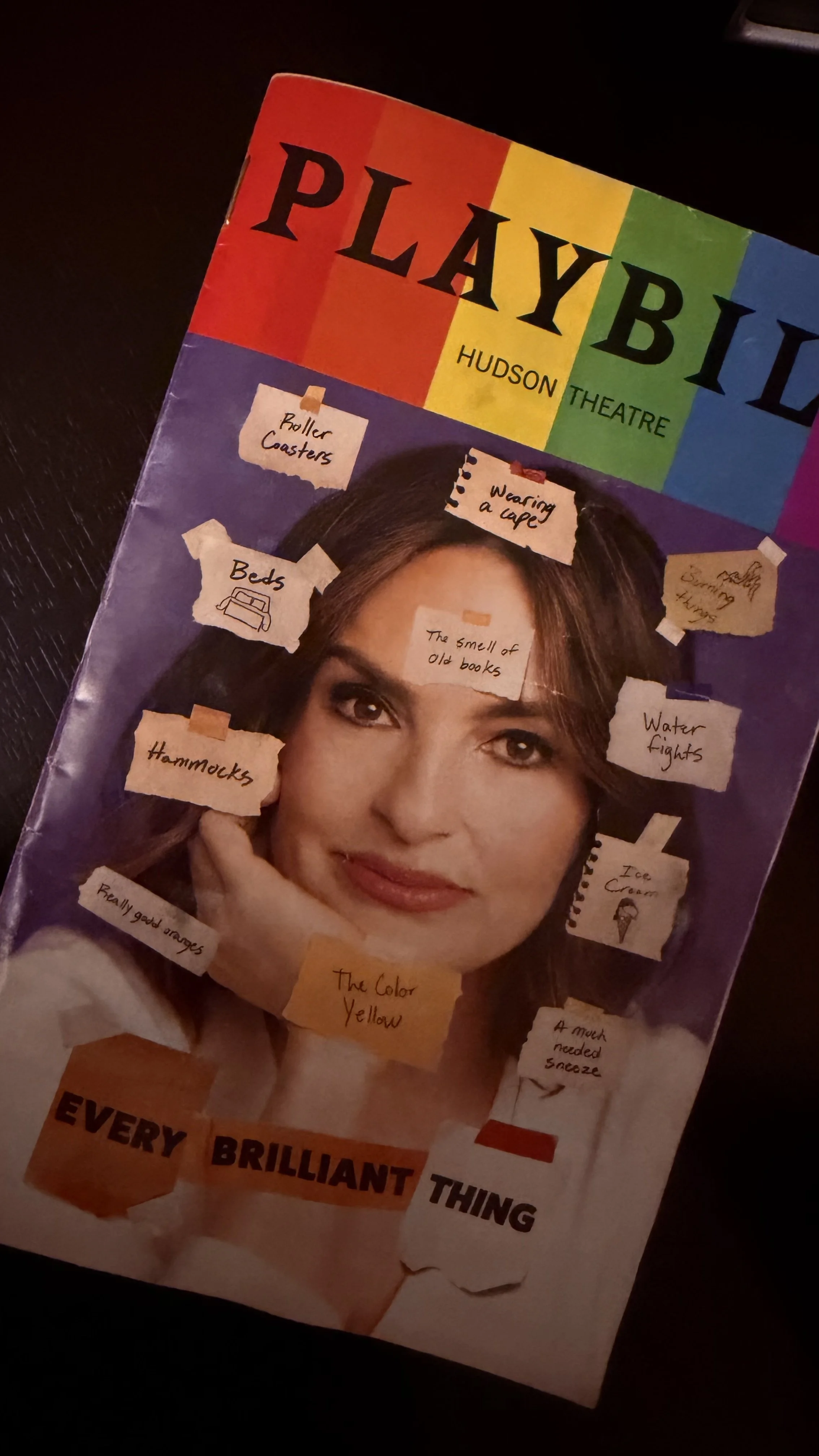
I have to indict myself a little here, I am very good at the enormous gesture and not nearly as good at the small one. I can spend months engineering a single unforgettable night and then walk straight past the vibrant smell of garlic simmering in olive oil on the stove when I get home. I glaze over the small moments while chasing the spectacular ones, and that misses the entire point. The spectacle is rare by definition. The small things are the ones actually available, every day, in unlimited supply, and I often treat them like they do not count because they do not photograph well or come with a trophy, a bonus, promotion, or a certification.
At some point in the play as the main character matures, a marvel occurs: the list spreads. Friends start adding to it, the boyfriend adds to it. People write in the margins, make amendments, leave footnotes, until the list is no longer one person's private survival document but a collective one, passed hand to hand. The thing built to save one life turns into something other people cannot stop contributing to. If despair can move through a family, the play makes a quiet case that the bright thing can move just as easily, and watching a theater full of strangers read brilliant things aloud to each other, I believed it and the contagion was felt.
By the end of the show, the storyteller is a full adult having lived a life, albeit with struggles and highs and lows. The list has been abandoned with the passage of time but then is returned to as the storyteller reengages with the list which may be a metaphor for the joys of life, it reaches one million. A million brilliant things, catalogued over a lifetime. This is the moment the whole premise of little things turns on itself. Because one million things is not small anymore. The individual items stay small, ice cream, water fights, staying up past bedtime, inappropriate songs playing at emotional moments, waking up late with someone you love, but the sum of them is enormous. It is a life's worth of evidence. A running audit of every reason there ever was to stay, kept faithfully enough that it becomes the largest thing the character owns.
That was a reframe for me. We dismiss the small moments because we measure them one at a time, and one at a time they lose to the spectacle every time. Nobody keeps a ledger. What the list does is insist on the ledger. It treats noticing as an ongoing act of accountability to your own life, a thing you revisit and add to and total up. The smallness was never the weakness, the smallness is what lets the number get to a million.
So I left the theater thinking if I started my own list, what would be on it? Not the career milestones, not the complex problems I've navigated but an actual list of brilliant things. My kids singing out loud in the back seat of the car, the smell of fresh bread in the oven, the first sip of coffee in the morning, leaves turning orange and red, running in Central Park when the temperature hits 48 degrees, my husband holding my hand in the middle of the night, the first spoon in a new jar of peanut butter. None of it would make a stadium gasp, but all of it is the actual point, and the longer I let the list run, the bigger it would get.
Attendance, gross, the volume of fifty thousand people on their feet at once. Those are the numbers I trust, the ones with a box office attached. A million brilliant things has none of that. No opening night, no receipts, just a quiet running total that somehow becomes the biggest figure in the building. That is the ledger that ends up mattering, and it is the one I have been too busy to keep.
So I want to start one with you. Drop a brilliant thing in the comments, one small, free, universal one, the kind a stranger could read aloud and recognize instantly. I will start. Number one: the first warm day when you step outside and realize you do not need a coat. Add yours. Let's see how fast this list grows and how the smile on your face feels when you read them.
From Your Biggest Champion,
Nicole
[1]The narrator is written as unnamed and is performed by actors of all genders across productions; the role has been played by Jonny Donahoe, Daniel Radcliffe, and others. The version described here reflects Mariska Hargitay's Broadway performance.
