
No Friction. No Feeling (not exactly what you think)
There is a brand that has spent over a century engineering the answer to one of the most fundamental human questions: how do you remove the friction without losing the feeling?
That brand is Trojan.
Stay with me.
Trojan’s entire product innovation history, every dollar of R&D, every iteration from latex to lambskin to BareSkin to Ultra Thin to their latest line literally called “Raw,” has been in pursuit of one thing: eliminating the barrier between two people while still preserving what matters most, the sensation and the connection. The experience of being fully present with another human being.
If that sounds like a mission statement for the hospitality industry, the experience economy, or frankly any brand trying to make someone feel something in 2026, that’s because it is. Trojan just got there first. And they did it with condoms.
I started thinking about this after a very unsexy moment in my apartment. One of my kids needed a calculator for school. The kind you and I would have driven to Staples to buy after comparing three options on the shelf, holding each one, pressing the buttons, and making a decision that involved at least a tiny amount of thought. Instead, I tapped a button on my phone. A ding confirmed the purchase before I put it down. And within seconds he asked: “Is it here yet?”
The calculator arrived the next morning. No store visit, no time involved, no relationship to the purchase at all. Just an idea that became a physical object so fast it might as well have been a magic trick.
It is not like anyone misses fluorescent lighting and checkout lines and the time it takes to go somewhere and find what you need, but somewhere between “I need this” and “it appeared,” an entire layer of human experience evaporated. The searching, the waiting, the choosing. The part where you learn that getting something takes a beat and that beat has value.
There is apparently a term for the counter-movement and it’s everywhere right now as we move further and further into seamless tech innovation. “Friction-maxxing.” Coined by columnist Kathryn Jezer-Morton in a viral essay for The Cut in January (in which she also casually used the phrase “raw-dogging your boredom,” so clearly she and I are circling the same metaphor), friction-maxxing is the deliberate choice to lean into life’s inconveniences rather than optimize them away. Pay with cash, cook from scratch instead of ordering from an app, read a difficult book instead of scrolling, you get it. Jezer-Morton’s argument is that tech companies have been so successful at eliminating friction that we’ve started to treat the basic vagaries of being a person, boredom, awkwardness, effort, discomfort, as problems to be solved rather than the experiences that actually shape us.
I love this because it is not just about analog versus digital. Friction is where the feeling lives and without the feeling, nothing sticks.
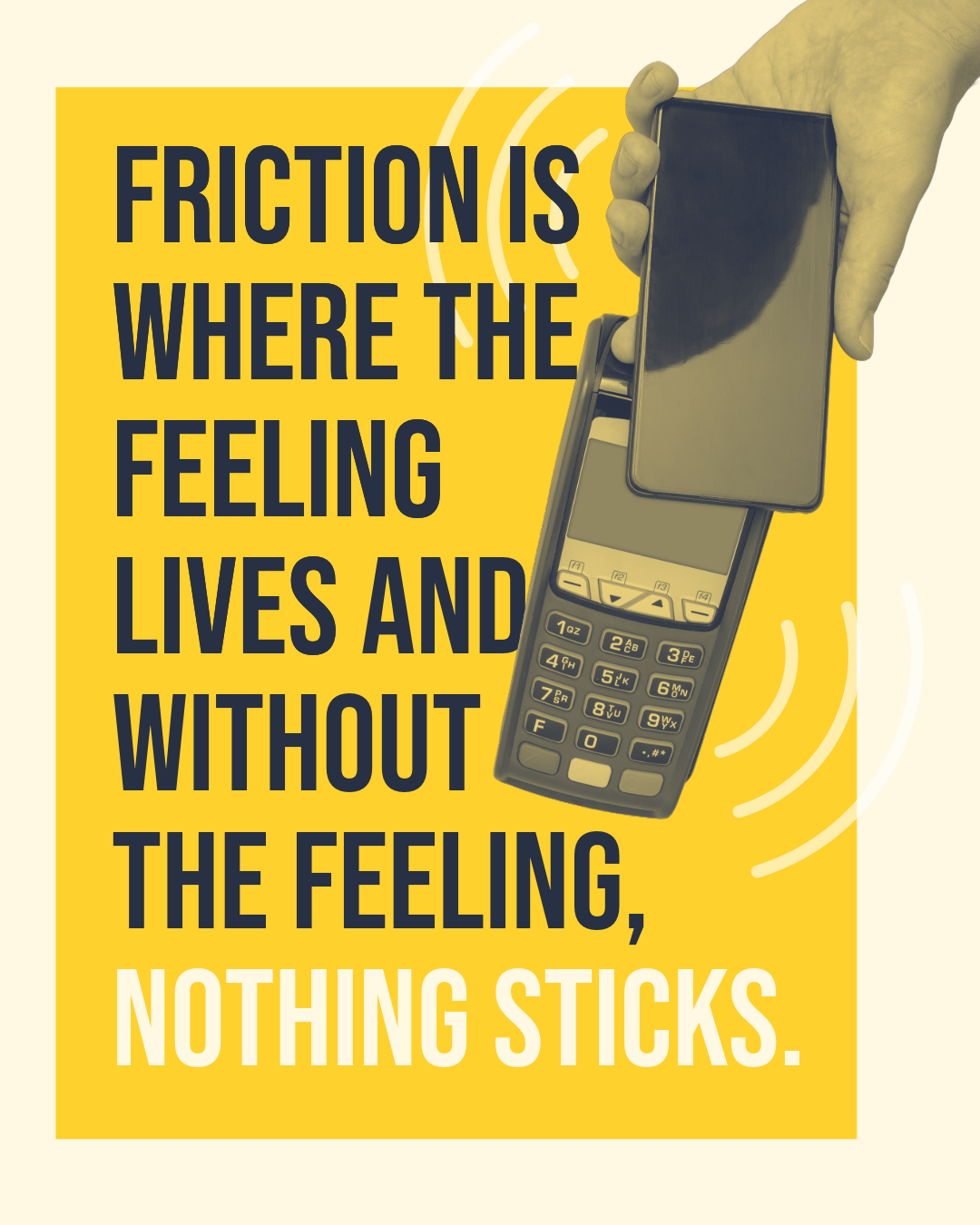
My husband and I give our kids an allowance. We pay them their age, in actual physical bills, every two weeks. Not tied to chores, not merit-based because we don’t get paid to make dinner and make our bed so they won’t get paid to do the dishes and make theirs. That’s called living with accountability in a household system. The allowance exists so they can hold money, feel it accumulate, watch it disappear, and sit with the choice that lives between the two. When our 14-year-old daughter earns fourteen dollars over two weeks and wants a Starbucks drink that costs seven, she does the math in her gut, not on a screen. “That is half of everything I have for one drink”. That lands differently when you’re counting bills than when you’re tapping a watch. They make change with the pastry cart guy on our block. They count bills at the ice cream truck. The ice cream man hands off the cone and counts back change at the same time. Two humans navigating a tiny shared moment. That is not inefficiency, it’s commerce in its purest form.
I am not anti-technology. I love that I can run through Central Park and grab groceries on the way home without bringing my wallet. If I didn’t need my reading glasses or want to reapply lipstick, I don’t think I’d even need a purse anymore. Frictionless has real, beautiful applications, especially in hospitality. When you stay at a premium resort and never see a check, when your drink appears poolside and your day ends without anyone sliding a leather folder across the table, you stop feeling like a customer and start feeling like a guest in someone’s home. Spending goes up, not because people are being tricked, but because they are relaxed and actually enjoying themselves and not being reminded that they are a transaction. That is the business case for emotional architecture.
But frictionless without foundation is a disaster. You need to understand how to earn money, how much you have, what your budget is, BEFORE you can spend it without seeing a bill. Skip the fundamentals and you are not living frictionlessly. You are just racking up a tab you can’t pay.
The same is true for brands. Hotels, restaurants, and airlines have more data about us than ever before. Your room preference, pillow style, towel count, dietary notes, celebration occasions, reservation history all sitting in a system, attached to your name. So why doesn’t the front desk greet us by name when we visit? Why does the server ask about allergies and dietary restrictions when they are already listed in the reservation? The technology exists to know us. It just doesn’t bother to.
This is where Trojan actually has something to teach every brand in every industry. Their marketing works because the engineering serves the experience. The technology is invisible. The human connection is the entire point. They never confused the tool for the outcome. Ultra Thin is not the product. The feeling is the product.
Now look at hospitality, retail, healthcare, any industry that claims to care about the customer experience. They are doing it backwards. Forrester has tracked customer experience quality for over a decade, and it has declined for multiple consecutive years. They are investing in systems and optimizing out the soul. They are collecting your data and doing nothing with it. They are removing friction in ways that also remove the human. It is the equivalent of engineering a product so frictionless that nobody feels anything at all.
My son was genuinely frustrated that a calculator didn’t materialize in his hand the moment he heard the purchase ding. I get it, that’s the world we’ve built for him. But you can only appreciate the ease when you’ve experienced the effort. And if you skip the effort entirely, ease just becomes an expectation and stops being a feature and starts being invisible.
The point was never to remove all friction. It was to clear the friction that gets in the way so the moments that matter can breathe. So you can be fully present with the person in front of you (or beneath you 😜), the meal on your table, the experience you traveled to have. Frictionless is at its best when it makes the lived experience more vivid, not when it makes the lived experience unnecessary.
Trojan figured this out in 1916.
The Pivot With Purpose community exists because showing up matters. Not the curated, algorithmically-timed version of showing up. The real kind. After spending two decades designing moments that made strangers in arenas feel something together at scale, I know that the same principles apply at the smallest scale too: making yourself unforgettable to the person standing right in front of you. That is the work and it starts with being willing to stay in the room.
From Your Biggest Champion,
Nicole
