
Where Your Scale Lives
Near the end of the second act of Les Misérables, Javert stands alone and sings himself off a bridge.
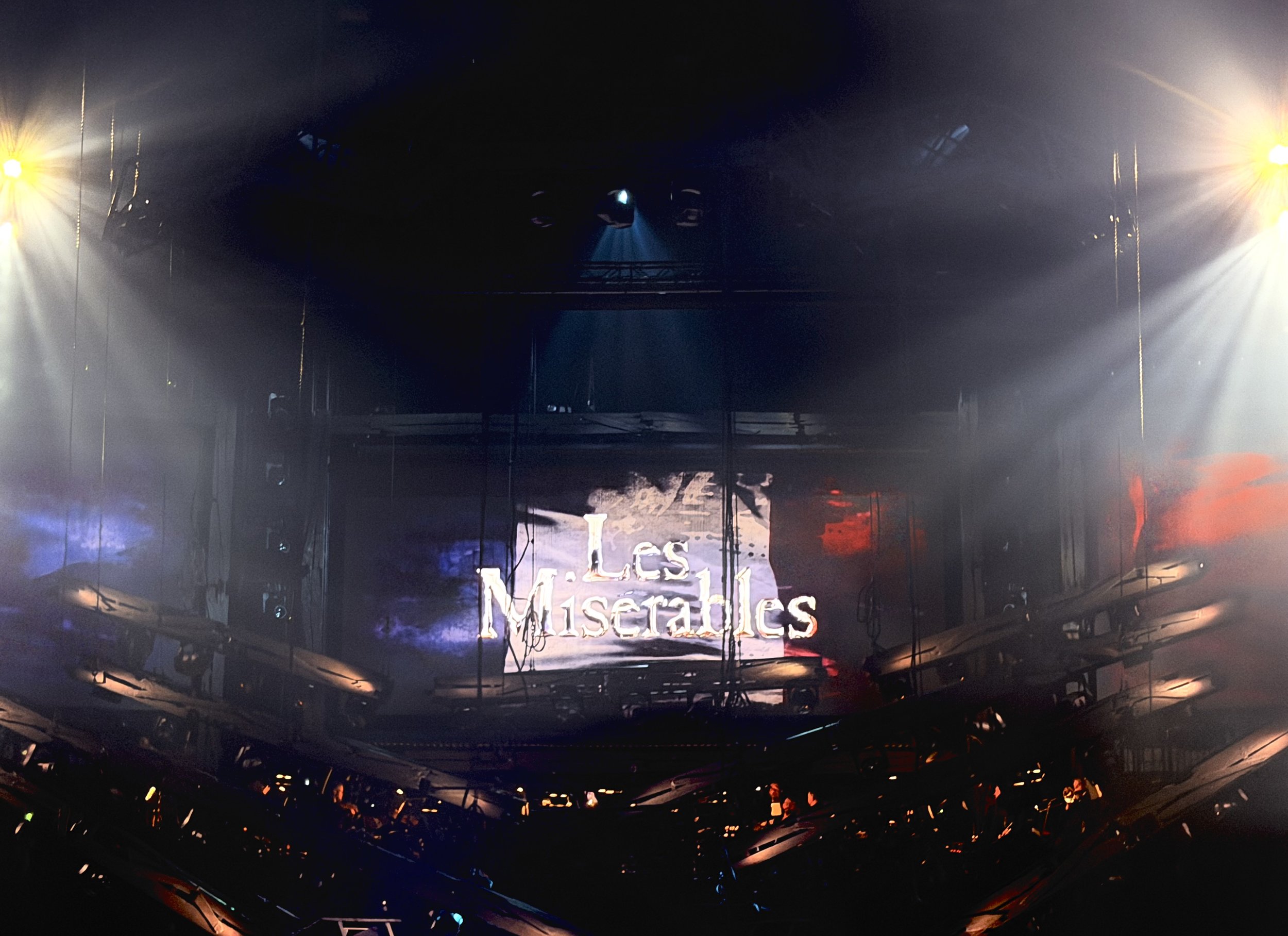
Earlier this week at Radio City Music Hall, I watched Bradley Jaden do that with a few spotlights on him and nothing behind him but an orchestra, and by the final note nearly six thousand people were on their feet. Vulture ran a scene report from opening night under the headline, New York City Has Javert Fever, so obviously I am not the only one who noticed.
Radio City holds 5,960 seats. For that stretch of the show, every one of those people was looking at the same square foot of stage at the same second and makes my case that scale is not how many people are in the room, but how many of them are feeling the same thing in the same second.
To be clear, there is nothing small about this production. Cast and orchestra together run more than sixty-five, it has played arenas across thirty cities, and the sound is built for rooms much bigger than this one. What it does not have is the iconic turntable, a barricade that assembles itself in front of you, complex choreography (or really any at all), or scene work between numbers. The program is a print out not a Playbill and it does not even print a song list, but mentions all the many who have made this production possible. The scale never left but it moved out of the machinery and into the voice.
Master of the House is the clearest case of the opposite approach when it was in its original form on Broadway and was drastically minimized here and it is worth being precise about why. That number has always been a juggling act. Bodies crossing, pickpocketing in one corner and a joke landing in another, musical staging and comic timing stacked so densely that the audience is happily overwhelmed and never entirely sure where to land. It is designed so your attention keeps moving. It is not built for a drum roll, a silence, one trick, and applause.
I am not making a case against scale. Scale is where I am most confident and most at home. The pressure around that word is real for almost everyone I know, the quiet sense that impact should be measured by how much you can get in the air at once. We have debated the metrics around such constructs in past musings. What I am less certain of now is whether more elements reliably produce more feeling. Past a point they start competing for the same attention, the audience splits its focus, and the moment gets smaller while the budget gets bigger.
In 2014, I was producing Disney On Ice, in the months right after Frozen came out and became the biggest thing anyone had ever seen. Let It Go was going to close the first act, and our director designed something genuinely spectacular for it: an Olympic-caliber skater as Elsa, the ensemble flying on ice-crystal aerial rigs, production elements assembling into her castle as the song built and her power built with it, audiences would head into intermission on that epic climb.
It was a beautiful design and it would have worked. Every element was doing something, and doing it well, and together they handed the audience a dozen places to look, a multi-sensory escapade that was layered majestically during the four minutes when everyone in that building already knew every word.
We made the call to take it all out and leave the skater, the choreography, the song, extraordinary lighting, pyro. That was the number. The entire arena belted it out along with the soundtrack. Thousands of people, out loud, all the way through, and I have never been so happy to have defied the very notion of what I thought I knew.
That only worked because of what was left standing, which is the part I would not want anyone to skip and lives in the title "on ice.” World-class choreography executed by a skater at that level, and a song the audience had a relationship with before they ever bought a ticket. Take either one away and the aerial rigs become the right answer, because then the apparatus is what carries the number. Taking things out is not a virtue on its own. It is a decision you earn by being honest about what you actually have. Trust the talent and the audience will trust it too.
Which brings me to why this is on my mind at all. Most of the people I work with are in the middle of a career transition or seeking something more within their own company, and almost all of them arrive running the Master of the House version of themselves. Everything at once, all of it good, none of it holding still. Three chapters of career, twelve credentials, the pivot, the sabbatical, the board seat, the thing they are exploring, all firing simultaneously because leaving anything out feels like lying by omission. They are convinced the problem is that they need more. More proof, more polish, more evidence they belong in the room.
What I have watched work is figuring out which parts were only ever being carried by production value, and which part would still land on an empty stage with a single light on it. That edit is hard, because the things you cut are usually the things you are proudest of having survived.
If you want to try it, set aside about thirty minutes. Write out everything you currently say when someone asks what you do. Cross out every line that only makes sense because something else in the paragraph is holding it up. Keep going until you reach what works alone. Whatever survives is your solo, and that is where your scale lives.
Doing that alone is harder than it sounds, because you are attached to all of it and you were there for all of it. Most of my work with people is sitting across from them while they defend a line and then hear themselves defending it. If you get stuck partway through your own list, that is usually the interesting part, and I am happy to be the second set of eyes.
Back at Radio City, when Javert finished, there was a beat before the room came apart. Six thousand people, one light, nothing on the stage but a man who had just decided he could not live in a world where the rules he built his life on turned out to be the wrong rules.
Nobody in that building was thinking about the turntable. Every one of us was in the same place at the same time, which is the only measure of scale that has ever mattered.
From Your Biggest Champion,
Nicole
