
You Didn’t Have To Say It
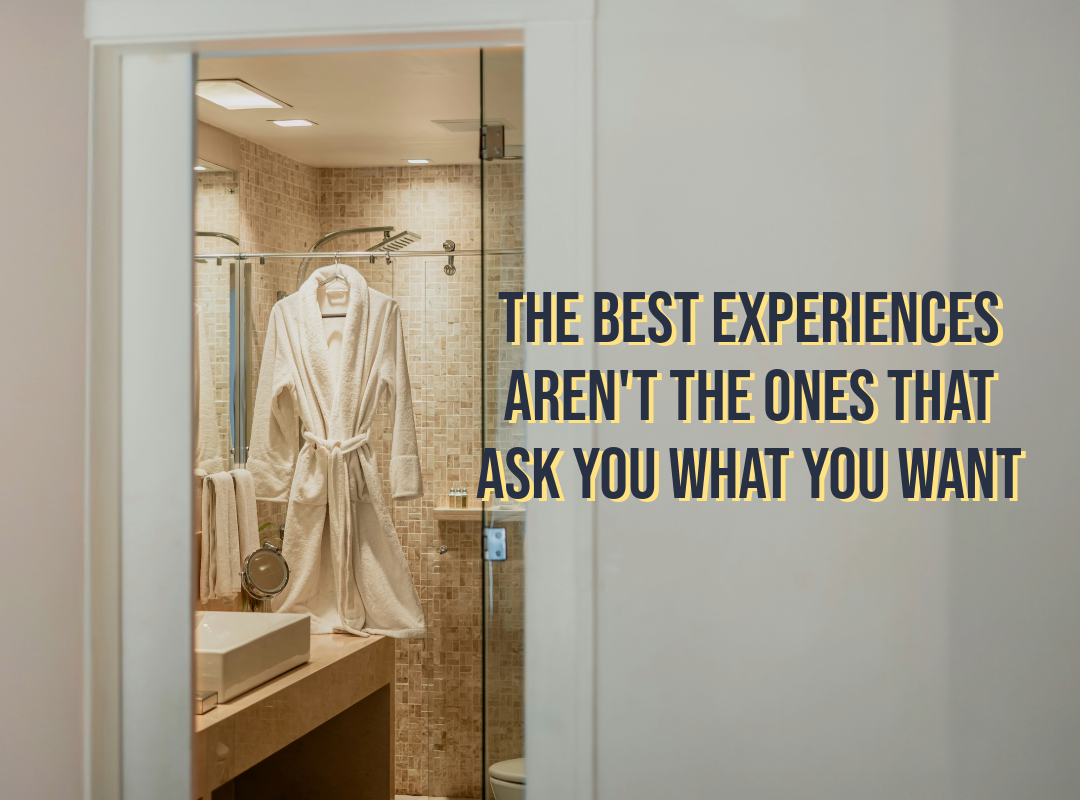
I returned to the hotel room and the bathrobe was smaller and not because I had asked anyone to change it. The first one had been hanging on the bathroom door when we arrived, a thick white thing built for a person considerably larger than me, the kind of robe that turns you into a kid playing dress up in a parent's closet. I'd been rolling the sleeves up my forearms just to find my own hands. At some point between breakfast and the afternoon, while we were out, someone had quietly swapped it for one that actually fit. Nobody mentioned it, there was no note. I only noticed because I went to roll the sleeve that used to swallow my hand and there was no sleeve left to turn.
That is the kind of thing I notice now, probably because I spent a long time on the other side of it, building the experiences people walk into. The water bottles exchanged while you're at dinner so the empties never accumulate on the nightstand. The charging cords untangled and laid flat when you'd left them in a knot on the desk. The dinner table ready at your reservation time, actually ready, not "just a few minutes" while you stand in the entry with your coat still on. None of these things announce themselves and that is the whole point of them. You feel the absence of friction without ever being able to name the thing that was removed.
Will Guidara wrote the book on this, literally, and I mean that as the compliment it is. When Unreasonable Hospitality came out I bought a copy for every member of our executive team, because he had managed to articulate in a few hundred pages the thing we had been delivering at scale for decades in arenas and stadiums full of people who came to feel something. His most famous story is a street hot dog, bought off a cart and plated like a Michelin course for a table of travelers who'd mentioned they were leaving New York without trying one. It's a perfect story that went around the world for a reason. I'm not going to retell the whole thing here because he tells it better and it's his to tell.
The mechanism underneath it is the part worth lingering on. The guests at that table never asked for a hot dog, they mentioned one. There's a canyon between those two things, and the entire art lives inside it.
For over twenty years my job was to figure out what people wanted from a live experience, and I learned early that you cannot simply ask them. We ran the studies, we surveyed customers and non-customers, lapsed attendees, every demographic you can slice. We asked them what would make them come, what they wanted to see, what was memorable, what was missing. And the answers were almost always some version of the thing they had already seen somewhere else, because that's the only vocabulary anyone has for desire, the stuff that already exists. People know precisely how they want to feel. They have almost no idea how to tell you how to make them feel it. That's not their failure. It's the job description. The work is to be good enough to give someone the thing they could never have requested, so that they walk out saying I don't even know how to describe what just happened to me, I only know I'd do it again tomorrow!
Which is why the survey has always struck me as a strange little confession. Every flight, every online order, every ride share, every hotel checkout now ends with a form. Rate your experience. How did we do? Would you recommend us to a friend? If you actually filled out every one of them you'd lose days of your life to unpaid work on behalf of companies that already have your booking history, your spend, your entire pattern of behavior sitting in a database. They have the camera. They have the receipt. They're asking you to do the listening for them, after you've already paid, and the deeper insult is that most of the time no one reads it or addresses it even when they tell you “We value your opinion.” You do the homework and it disappears. The asking becomes a substitute for the attention, and you can feel the difference in your body, because being surveyed and being known are opposite sensations.
I'll give credit where it's genuinely due. One resort sent the usual post-stay survey and I left a few honest notes, something about messaging in their marketing that hadn't matched the reality of the stay. A real person wrote back, an actual human who thanked me, addressed each point, and told me they were changing the language on the website. I have no idea if they did. It almost didn't matter. That email served to remind me that I was a valued respected guest who had been heard, and that feeling did more for my loyalty than any amount of points ever has.
This is the part I think we all underestimate, in hotels and in everything else. The hunger to be heard is not a customer-service problem. It's most of what people are walking around wanting. The parenting books all say the same thing, that the move is to let your kid talk without leaping in to fix or judge or solve, just to listen until they feel the listening. So much of what we share in this community is some version of that same need, the relief of saying out loud that the high bar of success doesn't feel the way we were promised it would, and having someone receive it without trying to talk us out of it. Being heard might be the most luxurious thing there is, and much of the time it actually comes at no cost.
So here's where the tomatoes come in, because of course this story ends with tomatoes.
There were these cherry tomatoes at the place we stayed in Vermont a few weeks ago, grown on a farm down the road, and they were genuinely the sweetest thing I have ever put in my mouth. I went on about them. To whom, I honestly couldn't tell you. A server, a person clearing plates, someone refilling coffee, I have no memory of saying it as a request because it wasn't one, it was just joy leaking out the way it does when something is that good. We checked out the next morning and as we were loading the car a member of the staff came out with a bag for the road inside was water, apples, and a pint of those tiny ridiculous delicious tomatoes.
Nobody had asked me to fill out a form about my tomato preferences, there was no field for it. Somebody was simply listening when I didn't know anyone was, which is the only kind of listening that ever actually lands, and they turned a thing I'd said into a thing I got to take with me. We ate them in the car somewhere around Massachusetts and I will remember that pint of tomatoes longer than I'll remember the thread count of the sheets.
The best experiences aren't the ones that ask you what you want, they're the ones run by people paying enough attention to hand you the thing you never knew how to ask for. You can build that without a budget. It just requires being awake to the person in front of you, which, it turns out, is the rarest amenity of all.
From Your Biggest Champion,
Nicole
