
Every year, in the days after the New York City Marathon, I come down with a mild case of marathon envy. This past Sunday, runners from all over the world took on all five boroughs, and New Yorkers did what we do better than anyone, which is stand on a curb for hours screaming for total strangers.
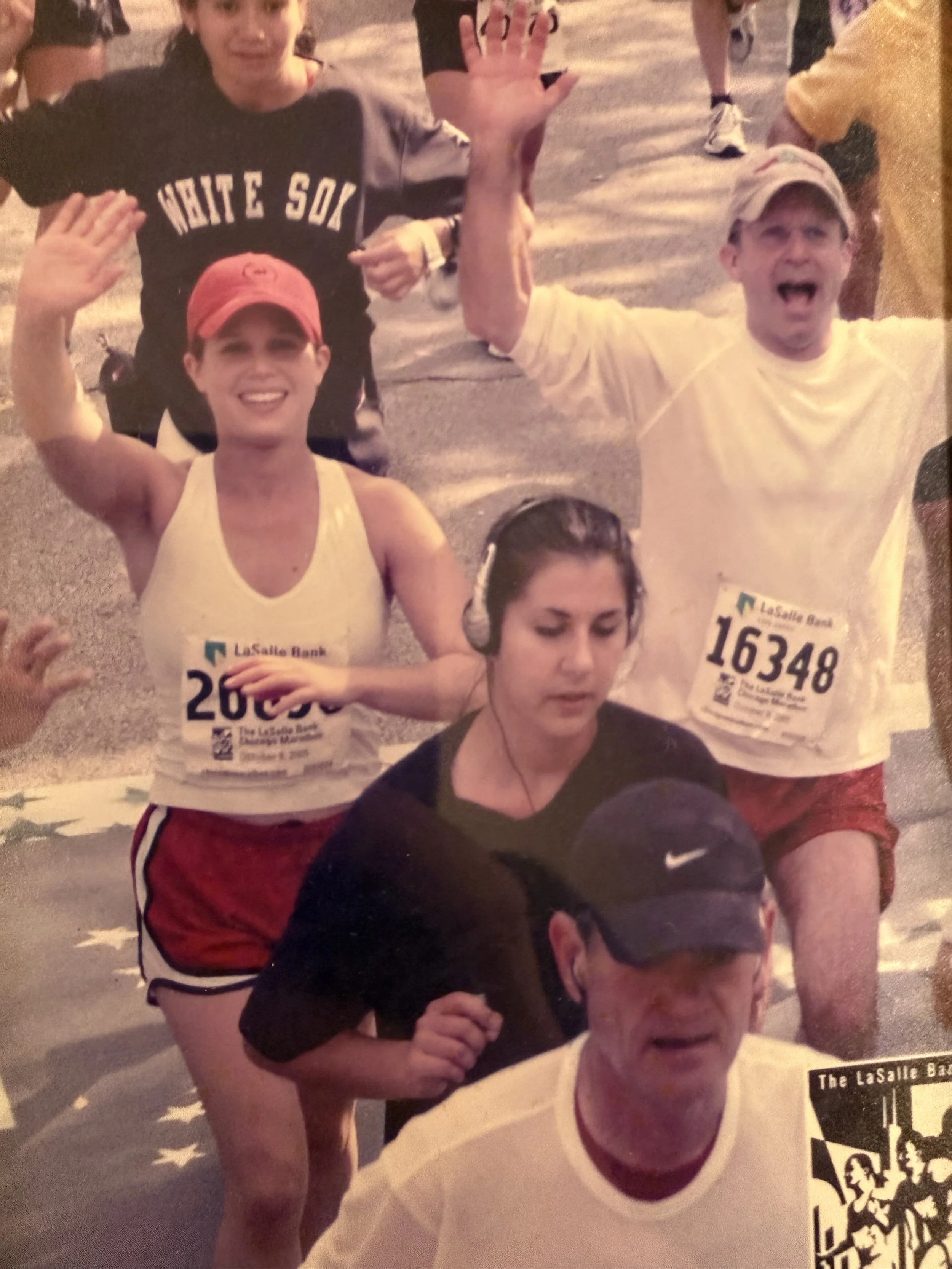
I have run exactly one marathon. It was the 2005 Chicago Marathon, I was in my twenties, and I ran it because my dad asked me to. We are exactly thirty years apart, and running it side by side is a memory that will sustain me for the rest of my life. I trained hard, though nowhere near hard enough. Part of the fun was getting up early in whatever city work had sent me to and learning it by running through it. I remember steaming August mornings in Florida, circling lakes with my dad before we headed indoors for a long day of ice show rehearsals. What got me through race day was some combination of youth, arrogance, stubbornness and my father, roughly in reverse order.
The discomfort started early. Nothing says father-daughter bonding like peeing in an alley off LaSalle behind a trash container around mile three, with twenty-three miles still to go. That turned out to be the easy part. By mile seventeen I was ready for it to be over. I had sworn I would never touch the energy gels runners call goo, and suddenly I couldn’t get enough of them. I would have traded almost anything to make it easier and leapfrog to the finish line, and there were still more than nine miles left. Quitting never crossed my mind, though plenty of other things crossed my lips. My dad still tells people that somewhere in that stretch his daughter developed a vocabulary he had never heard from her before. I’ll let him keep the specifics to himself.
At the finish line I was greeted with glory, donuts and a beer. Mostly I felt disbelief that my body had pushed through and my mind had gotten me there. I also remember the strangers lining the course with handmade signs, yelling for every runner who passed, believing in me right when I was at my most miserable.
I never ran another one. My hamstrings were wrecked for months afterward, and being sidelined turned out to be harder than mile seventeen. Mile seventeen at least had a finish line.
As a kid I never thought of myself as athletic. In my teens I started running for fun with a neighborhood friend, and it stuck. People have commented on my athletic frame for years, and I still don’t call myself an athlete, but I do call myself a runner, and I have for thirty-two years. Plenty of my other identities arrived on their own schedule, and a few came and went. I wasn’t a wife until I married or a mother until I became one, and my work identities have changed more than once. Runner has stayed through long training blocks, through injuries that kept me benched for weeks, and through stretches where ten or fifteen miles a week was the entire program.
Shakespeare gave Henry IV the line “Uneasy lies the head that wears a crown,” which most of us have turned into heavy is the head. I don’t own a crown (although you know I own a cowboy hat), but I know the feeling. The identities I hold onto hardest, business owner, runner, and mother among them, are the ones that cost me something. I don’t think you get to wear those hats because the road was easy, and the weight is part of how I know they’re mine.
Not everything needs to be hard, and I’m grateful for the things that aren’t. I’ve also noticed that the moments I’m proudest of never felt comfortable while they were happening.
The discomfort I’m most likely to dodge has no race bib attached. It’s the networking meetup where I don’t know anyone, or the intimate dinner party for women founders where I suddenly feel like someone let me in by mistake. More often it’s the conversation I keep moving to next week, because I already know how the first five minutes will feel or the tough project I don’t know how to start. Nobody hands out water for any of it or holds a sign saying “You can do it,” though the feeling at the end is the same one I had at the finish line in Chicago, minus the beer.
What I rarely think about in the moment of dodging is who’s watching. I ran that marathon because my dad asked me to, and not wanting to let him down was a big part of what kept me moving at mile seventeen. Our kids watch how I handle hard things the same way I watched him. The friend who saved me a seat notices when I don’t show, and so does the person waiting on the conversation I keep postponing. When I skip the hard thing, I’m also telling them what I’m willing to carry.
So I’ve been trying a couple of things. When I’m dreading something, I place it on the course. The first ten minutes of a hard conversation feel a lot like mile two, stiff and not yet warmed up, and mile two rarely tells you how the race will go. I’ve also started asking who asked me to be there and who’s counting on me to show, since that’s usually what gets me out the door. I still check whether I’m facing discomfort or actual pain. Some nights the honest answer is the couch, the same way some weeks the honest answer was not running. On the nights I’m not the one who has to be brave, I can be the stranger on the curb, showing up for a friend’s launch or her hard dinner, holding the sign.
I’ve told my kids that if they ever want to run a marathon, I’ll run it with them, if my dad is up for it. We should all be so lucky, the four of us out there together, with my husband holding the donuts and the medals.
From Your Biggest Champion,
Nicole
