
Last weekend at a party, I was intercepted on my way to the bar. A man and his adult son had found their next guest.
The son went first, with facts and a run of jokes that landed beautifully for an audience of one. He seemed to believe his job was to entertain me. Then his father took over with questions. How did I know the hosts? Did I live in the city? Each time I answered and tossed one back, he gave me a word or two and returned with another question. A few rounds in, I realized I was being interviewed, politely and thoroughly, by a man with no intention of being interviewed back.
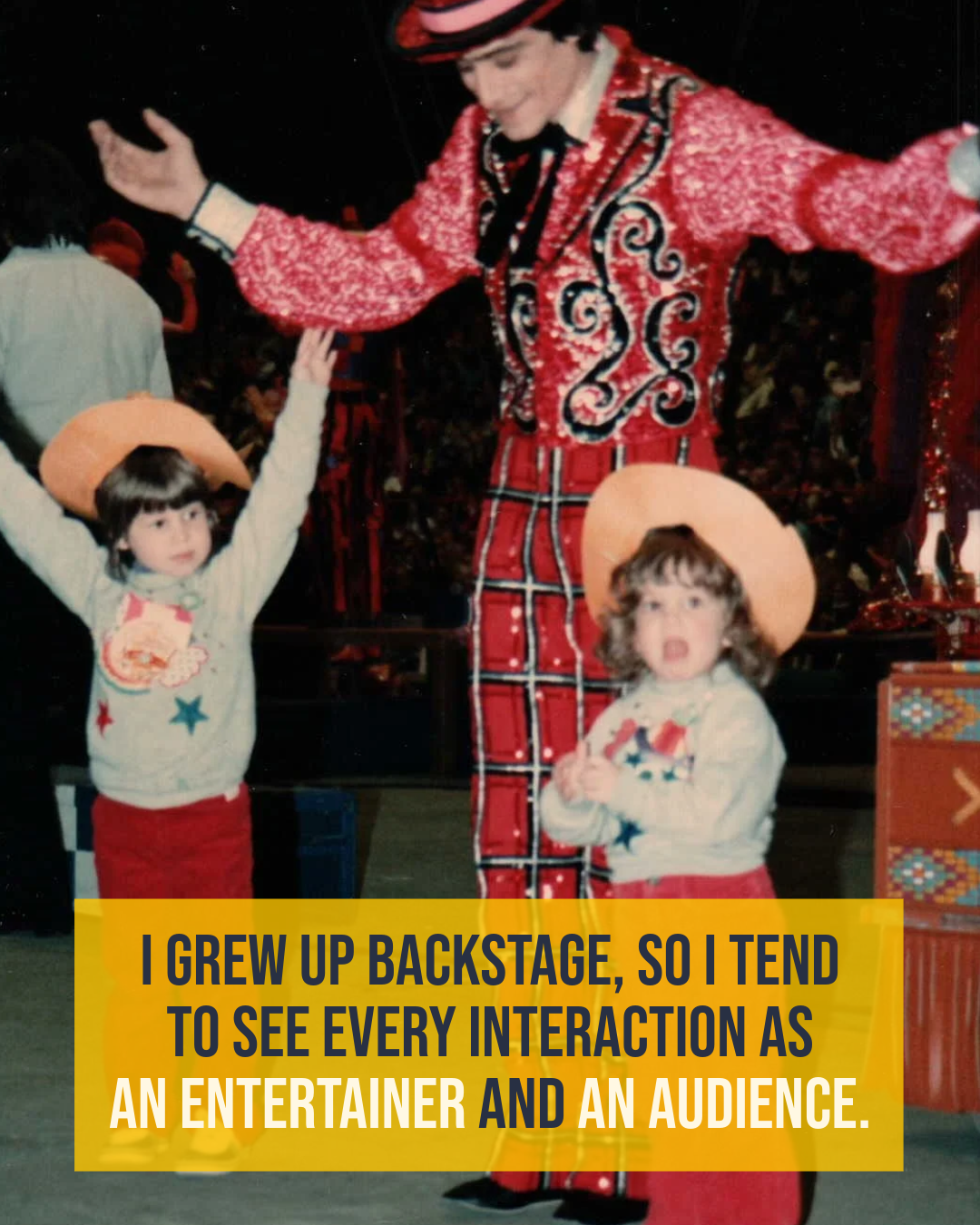
I grew up backstage, so I tend to see every interaction as an entertainer and an audience. Most of us lean toward one seat without noticing. The son had claimed the stage, and his father had settled into the back row and was waiting for the show to start.
You can usually spot the difference between entertainer and audience within a minute or two. Entertainers give answers longer than your question and roll from one story into the next. Audience members give you the short version and volley the question right back so they can listen. A good audience still reacts, laughs and asks what happened next. The father kept moving to his next question as if my answer had never arrived, which made him less an audience and more of an interviewer.
Once you spot that dynamic, you have a choice. You can try to turn it into a real exchange, or you can thank the room and take your bow. Both are solid options depending on how intent you are on making this connection stick.
Turning it around
My first move is to give the other person something to hold onto. I lean entertainer, comfortably, and given a minute you’ll hear about the time I folded myself into a clown car or sold popcorn to circus-goers. So I offer one short story, then a prompt specific enough that they already have an answer tucked away.
It might sound like this. Someone asks where I live, and I tell them New York, and that I love how every neighborhood has its own personality. In fact, I recently stumbled into the middle of a procession for the Lord of Miracles, right in Hell’s Kitchen. Generations of Peruvian families were singing and praying, with street food stands lining the sidewalk. I had no idea how much Peruvian heritage lived in my own neighborhood. I also nearly tripped and took down an entire food tent, and was rescued by a saint of my own.
Then I flip it. “Do you have a favorite neighborhood tradition, here or back home?”
“Where are you from” gets you a place name. A specific prompt gets you a memory painted with details about who they are. If they give me even a sliver of one, I ask about the detail they rushed past. With a performer like the son, I do the reverse. I’m a generous audience for a while, then I add a small story of my own, which signals I’d like a turn.
Taking your bow
Sometimes none of it lands. Someone keeps declining to say more, or keeps performing past every opening you offer. That’s a cue of its own.
A study led by Harvard researchers looked at 932 conversations and found that only about 2 percent ended when both people wanted them to. In nearly half, both people would have preferred to stop sooner. The person across from you may be hoping for an exit as much as you are.
That makes a graceful exit a kindness. I keep mine short and true. I thank them for something specific from our conversation, then name where I’m headed, whether that’s a friend I promised to find or a host I haven’t greeted yet. A real reason lets you both walk away with the evening intact.
As for the father-son duo at the bar, the son eventually wandered off, perhaps in search of a more willing mark for his jokes. I tried taking my bow the subtle way, drifting across the room toward my husband. The father drifted right along with me. A devoted audience, it turns out, will follow the show on tour! Finally I pointed out that dinner had been served and mine was waiting, which happened to be true, and I took off. It was the first seat I’d had all night.
From Your Biggest Champion,
Nicole
