
The Battle Standard and the Business Of Devotion
My husband and I pulled off the highway in Connecticut because we wanted lobster rolls.
In the strip mall next to the lobster place was a storefront called The Battle Standard. We had no idea what it was. The name was good enough that we wandered in on our own, two adults with no agenda, and what we found was a tabletop gaming store, the kind of place built for people who play Magic: The Gathering, Dungeons & Dragons, and miniature war games. Our son would have gone out of his mind, but we didn't have him with us, which is almost the point, because I wasn't there as a parent indulging a kid. I was there as a stranger, and I started paying attention to the room, because the room was doing something I recognized.
It's 13,000 square feet. Custom-built gaming tables, seating for a hundred and fifty people, a bar serving food and drink, shelves of product, and a calendar packed with tournaments and game nights. The owner, a man named Jared Brodeur, opened it in 2010 and has expanded twice since, doubling the space each time. He built it because he wanted tabletop gaming to be consumed the way people consume console games and streaming, as a real entertainment category, not a niche you apologize for. He was on the floor while we were there, energized in a way you can't fake, visibly lit up by the people he'd gathered into his room.
I know that feeling from the other side of it. Having spent years making live spectacles for eager audiences, I recognize that thing Jared has, the low hum of a host watching his people enjoy what he made for them. It is the most addictive feeling in the business. It's also the rarest, because most people building experiences are too busy measuring them to feel them.
What got my attention was the shape of his bet. Jared isn't chasing the one-time visitor. Everything about the space is engineered for the regular. The food and drink mean nobody has to leave to meet a basic need and break the spell. The product is right there so the passion and the purchase live in the same place. The events give people a reason to come back on a schedule. He removed every reason a person might cut the night short and head home, and he kept the cost low enough that showing up often isn't a luxury decision. He understood that a community can only form if the same people can convene regularly, which means accessibility isn't a nice-to-have, it's the entire foundation.
You can build community online. People do, constantly, in forums and group chats and ranked competitive ladders, and it's real connection, I'm not knocking it. Something different happens, though, when it goes from digital to analog. When a fan gets in a car and physically shows up, a whole different set of emotional levers gets pulled, presence, recognition, the electricity of being in a room with people who care about the exact thing you care about and don't need it explained. The trouble of getting there is not a tax on the experience. It is the experience.
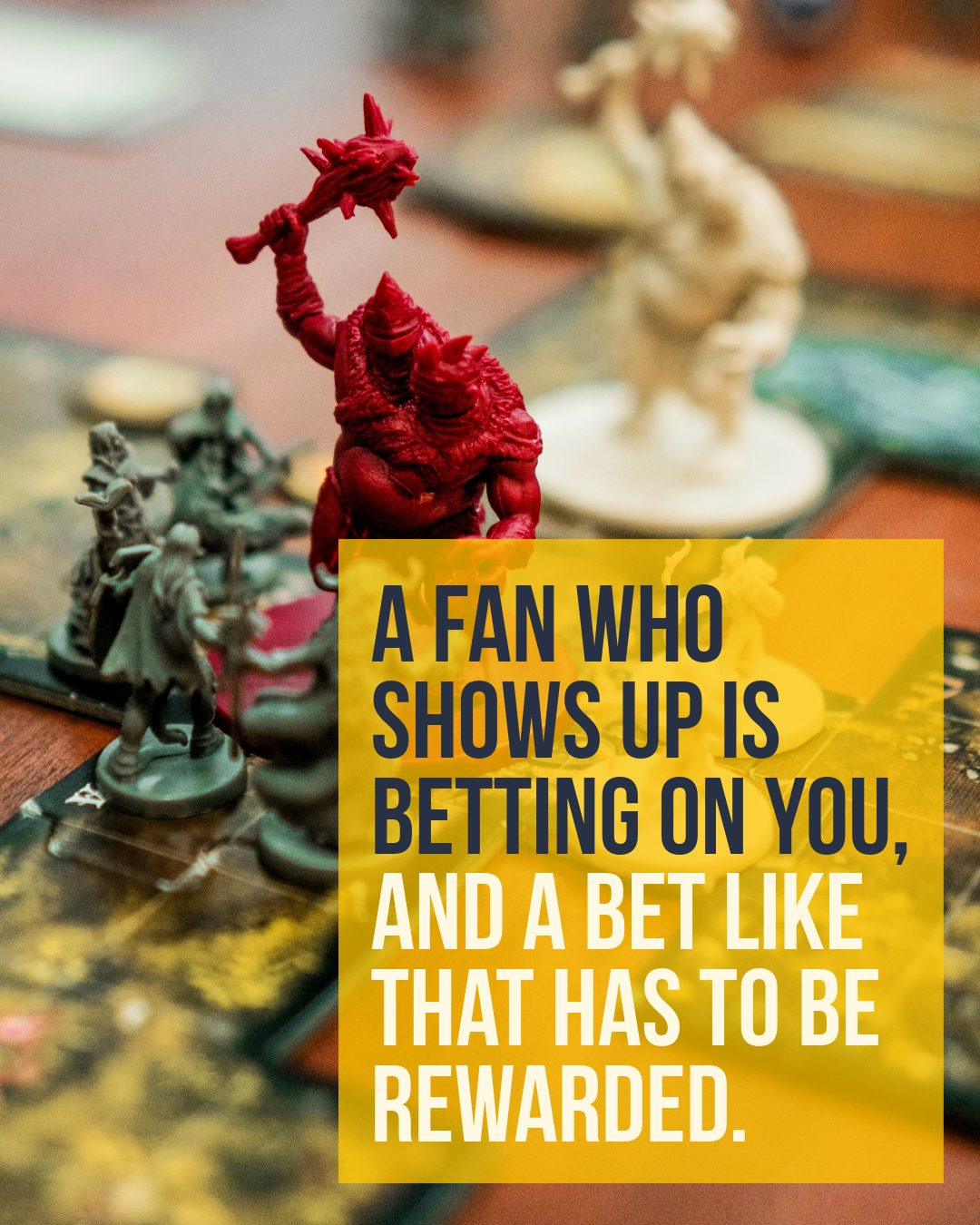
I learned that at the largest possible scale. The fans who travel for Monster Jam World Finals, or to watch their favorite rider compete in a Supercross event are not casual. They plan around it, they spend real money, they buy multiple tickets for members of their family, they wear themed jerseys, t-shirts, and hats. They drive distances that would make most people balk, all to be in community with other people who feel the way they feel. When someone rearranges their life to attend the thing you made, it is the highest honor they can pay you, and it comes with an obligation. You cannot phone in the experience for a person who went to that trouble. You have to make it worth what they spent to get there, and then make it worth more than they hoped, because a fan who shows up is betting on you, and a bet like that has to be rewarded.
Jared is running the small-scale, analog, beautifully un-scalable version of exactly that. A 13,000-square-foot room in Connecticut built on the radical premise that if you make a place worth showing up to and treasure the people who show up, they'll keep coming back, and they'll bring others. He's betting on devotion, and he's honoring it when it arrives. That's not a card-shop strategy. That's the whole business of live experience, distilled down to one room and one very alive guy who clearly loves his fans.
We told our son about it that night. He has asked twice since when we can go back, and it's not close to us, and he does not care even a little. Somewhere Jared is doing exactly what he set out to do, and he doesn't even know our kid's name yet.
If you're building anything that depends on people choosing to show up, that's the question I would make sure you are answering. Not how do I make this easier to reach, though that matters. The deeper one is this. When someone does make the effort to be here, what am I doing to prove it was worth it. The fans who travel are telling you something, and the only mistake is to treat it as expected.
From Your Biggest Champion,
Nicole
