
The Popsicle Theory
There is a moment on every airplane that I have come to both love and dread.
Someone sits down next to me, we do the polite nod, and somewhere between takeoff and cruising altitude they ask the question: “Are you traveling for business or pleasure?”
I used to answer “for business” and then say that I produce some of the most iconic global live entertainment. (Eventually it just got easier to say I drive for Uber.) And every single time, before I can even finish the sentence, the person next to me lights up and tells me about the first time they went to the circus, or about the concert that changed their life. Or how they just took their kids to Disney World and their son cried when he met Buzz Lightyear. They don't ask me about logistics or production budgets. They tell me how it made them feel. And honestly, apart from wanting to put my headphones on for the remaining three hours of the flight, that moment gives me goosebumps because that person just told me what I actually did for a living better than any resume ever could. I was in the business of making people feel something. And the proof was sitting in seat 14B.
What is kind of wild about that exchange is that also, in itself, is a feeling. A stranger sharing a memory, unprompted, because something I said unlocked something in them. That is human connection. And it happened at 35,000 feet between two people who will probably never see each other again.
I bring this up because right now, every brand in America is scrambling to figure out what the live entertainment industry has known forever: the product is the feeling.
Netflix is opening physical "Netflix Houses" in multiple cities. Lululemon builds loyalty through free in-store yoga classes, not discounts. Sixteen cities across three countries are bracing for the 2026 FIFA World Cup, and destination marketers are not just selling hotel rooms, they are selling proximity to a moment. The experience economy is no longer a trend piece, it is the economy. According to the World Economic Forum, consumer spending on live experiences has increased 70% relative to total spending since 1987, and that number keeps climbing. As AI makes digital content infinite and cheap, the things you cannot automate become more valuable. A room full of strangers all holding their breath at the same time, the collective exhale after an athlete sticks the landing. The electricity when a stadium of 70,000 people sing the same lyric at the same moment. You cannot replicate it. It is live for you in that moment at that exact time and that is exactly what makes it worth something.
Where most companies go wrong is that they hear "experience economy" and they invest in spectacle. Bigger LED walls, flashier activations, more immersive technology, customized swag and favors. They are building the set without understanding the story.
Technology is not the problem, technology is a tool. The problem is when the tool becomes the entire strategy. Look at what The Sphere in Las Vegas did with The Wizard of Oz. They built a staggering immersive environment: 160,000 square feet of curved LED, haptic seats, wind, scent, drone-powered flying monkeys. But the reason it works is that they started with something people already feel deeply about. Every person walking in is carrying a memory of Dorothy and "Somewhere Over the Rainbow." The tech does not create the emotion, it amplifies a feeling that already exists. Strip The Wizard of Oz out of that building, replace it with generic content, and you have impressive architecture. You do not have a story anyone recounts at dinner or on the plane ride home.
There is science behind this. Research from Dr. Elizabeth Kensinger at Boston College has shown that emotional arousal is what encodes experiences into long-term memory. When your brain's amygdala fires alongside your hippocampus, the sensory details of that moment get locked in. Not because the room was impressive. Because the room made you feel something across multiple sensory touchpoints. Companies are spending millions on visual spectacle and neglecting the emotional tissue underneath it.
Let me give you an example of where I saw this done perfectly, and it was not at a concert or a show. It was at a hotel pool in Cancun.
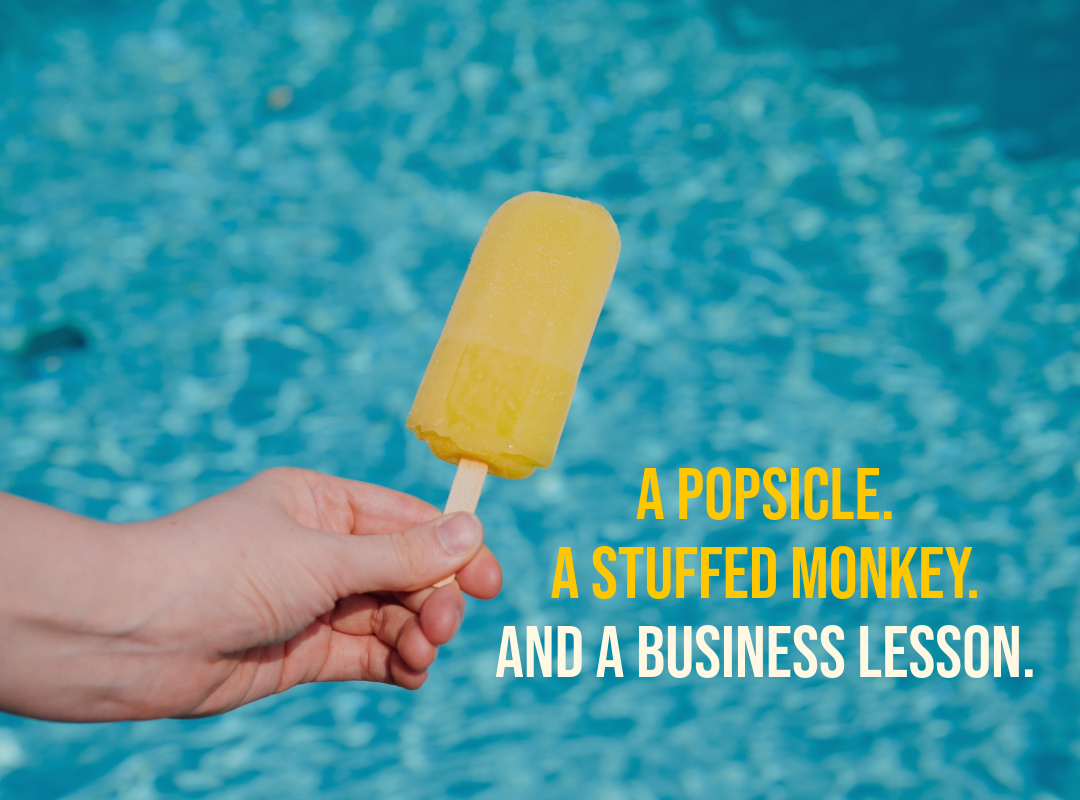
Our family was on vacation, and our daughter, then seven years old, cut her toe on something at the bottom of the pool. She was screaming, we were running, blood was dripping. And then, out of nowhere, four hotel staff members appeared. One with a medical bag, one with towels. A third carrying a giant frozen popsicle and a stuffed monkey, and a fourth who dove straight into the pool to find whatever had cut her.
The crying stopped. She sat there happily licking away at the popsicle and playing with the monkey while the medical staff cleaned and bandaged her foot. Meanwhile, the pool detective (my new favorite job title) emerged from the water holding the piece of broken glass lurking at the bottom.
That was seven years ago. I could not tell you what we ate for dinner that week. But I will never forget that resort and the way they made our daughter feel. She does not remember the cut. She remembers the popsicle. No popsicle can ever live up to that popsicle. That is the experience economy. Four people who understood that their job was not to fix an injury. Their job was to fix a feeling.
Whether you are running a retail floor, leading a team, hosting a conference, or checking someone in at a front desk, the question is the same: are you designing for the transaction or for the feeling? A few things to sit with:
Audit for memory, not metrics. After your next conference, event, or customer interaction, ask yourself: what will people remember about this in a year? If the answer is "nothing," the experience was not bad. It was forgettable and forgettable is more expensive than bad, because at least bad gets talked about.
Invest in the popsicle. The resort in Cancun did not spend a fortune on my daughter's experience. A popsicle and a stuffed animal. What they invested in was anticipation and care and demonstrated it through careful human training. They had thought about what a scared child needs before a scared child ever showed up. That kind of emotional preparedness costs almost nothing and creates a memory that lasts almost forever and keeps guests returning.
Lead with the feeling, then let it travel. Experiences create more lasting happiness than material purchases in part because they foster social relationships. We share them and retell them. The World Economic Forum points out that this massive shift has been waiting for the perfect convergence: overconsumption and the social platforms to amplify it. Social media is not the enemy of the live experience, it's the megaphone. But a megaphone only works if there is something worth amplifying. When the feeling is real, people share it not as content but as a story. The difference between a post that disappears in a feed and one that becomes a conversation beyond the feed is whether it started with a feeling rather than just a photo op. And by the way, FOMO is a feeling.
I spent over twenty years sequencing emotions for arenas full of strangers. Getting 10,000 people to gasp, then laugh, then cry, then cheer, all in the right order. I did not have the language for it then, but naming it now, I am an emotional architect. And what I have come to realize is that this skill does not belong to the entertainment industry alone. It belongs to every industry. It belongs to every leader. It might be the most valuable skill nobody is teaching.
So the next time someone sits down next to you on a plane and asks what you do, pay attention to what happens next. Because if they light up and start telling you a story, you are already in the feelings business. You just might not know it yet.
From Your Biggest Champion,
Nicole
