
The Section That Fell
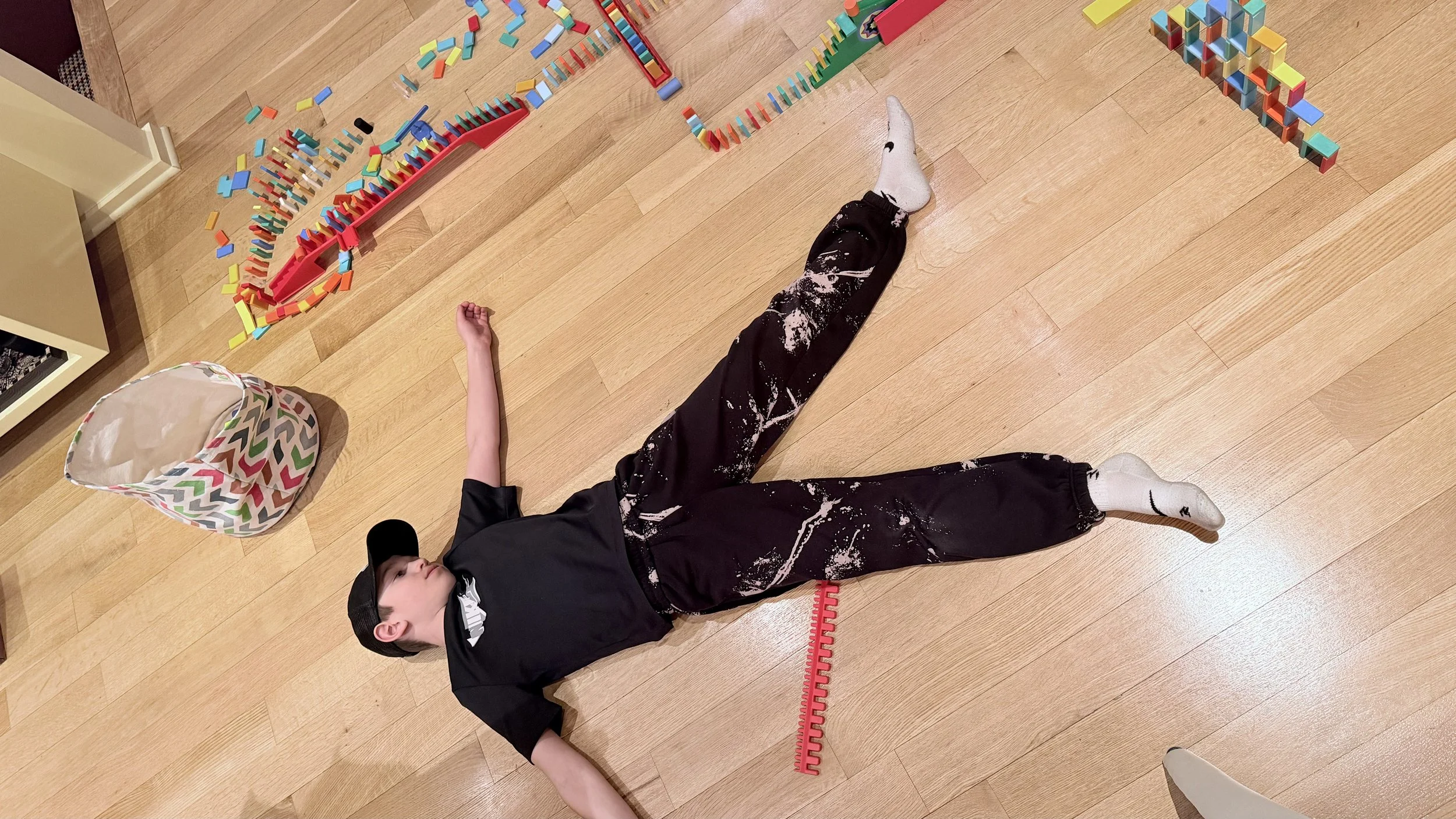
I spent most of this past weekend watching my 12-year-old son play with dominoes.
Not on a screen, not a video game version. Actual, physical, hold-them-in-your-hand dominoes that had been sitting untouched in our house for years. We had just gotten home from a family trip out west, and somewhere between unpacking and settling back in, he pulled them out and started building.
I don’t know what drew him to them and I didn’t ask, I just watched.
What started as a simple line became an elaborate design. He was on the floor for hours, placing each piece with this quiet intensity I don’t always get to see in him. The focus, the precision, the way he’d study the spacing between tiles, adjusting by millimeters, testing angles, engineering something in his mind that didn’t exist yet and willing it into physical form one piece at a time.
It was mesmerizing and then it collapsed.
A floorboard shifted, or the spacing was slightly off. Or maybe he just exhaled at the wrong moment. Whatever caused it, a full section of his carefully constructed design toppled before he was ready. He sighed loudly, shook it off, and rebuilt. It collapsed again. He rebuilt again. A different section this time, a different flaw, the same result.
And then came the moment where the frustration overwhelmed the focus and he just lost it. After hours of meticulous, patient work, he broke down, and I mean broke down. The kind of devastation that only makes sense when you understand how much someone cared about the thing they were building.
My husband and I sat with it. We didn’t rush in to fix it. Partly because we knew he needed to feel it, and partly because there was nothing to fix. The dominoes weren’t broken, his spirit was, and those require different tools.
Then his older sister walked into the room. She didn’t touch the dominoes. She didn’t rebuild the section that fell. She didn’t offer a strategy or a shortcut or a YouTube tutorial on better domino spacing. She just sat near him and said the kinds of things that don’t sound like much when you write them down but mean everything when you’re the person on the floor. You’re so close. This is going to be amazing. I can already see what you’re building.
Not solutions, presence. Not expertise, belief.
And it was enough. He got back on the floor.
This is one of her best qualities, by the way. Our daughter is a world-class sideline cheerleader. She doesn’t need to be in the game to change the outcome. She stayed up late with him that night, long after my husband and I had gone to bed, sitting on the floor keeping him company while he rebuilt the section that had broken him two hours earlier. She didn’t build a single thing. She just refused to let him build alone.
And when it was finally finished, he called us all into the room. There was a formal countdown, which made us laugh and also somehow made the whole thing feel like an event. He placed his finger behind the first domino, gave it the smallest push, and the chain began.
Every piece fell exactly as he’d designed it. One after another after another, this beautifully choreographed cascade of intentional destruction, curving through the patterns he’d spent a day and a half constructing. We held our breath. When the last domino landed, we erupted.
And then he said something so deeply profound, quietly, almost to himself, like he was processing what he’d just witnessed: “A simple little movement can have a big effect.”
He’s 12.
In 1983, a physicist named Lorne Whitehead published a study in the American Journal of Physics demonstrating that a single domino can topple another domino 50 percent larger than itself. Line up just 13 dominoes in a geometric progression and the force of that first small push amplifies by a factor of two billion. The last domino in that sequence would be the size of a small building. Physicists have studied this. Behavioral scientists have written about it. Business strategists have turned it into a growth framework. The domino effect is well-trodden territory.
But nobody talks about what it feels like to be the person on the floor when the section falls.
Nobody writes about the moment when you’ve been building something with care and intention and patience, and the floorboard shifts, or the market shifts, or the relationship shifts, and you watch the thing you were so close to completing just come apart. And you rebuild. And it comes apart again. And at some point you stop seeing it as a setback and start seeing it as a sign that maybe you were wrong to try.
That is where most of us live at some point. Not in the physics of momentum but in the emotional wreckage of lost momentum. In the liminal space between “I had a vision for this” and “I don’t know if I can do it.” Where perfect becomes the enemy of good and so we do nothing. Where the distance between where we are and where we want to be feels so vast that we can’t even place the next piece.
My son didn’t redesign his entire project after every collapse. He rebuilt the section that fell and kept going. He didn’t do it by thinking his way out of frustration. He did it by feeling his way through it, and by having someone show up who reminded him that what he was building mattered.
His sister didn’t hand him a blueprint, she handed him belief. And I think that’s the thing we underestimate most when we talk about momentum. We treat it like a physics problem. Apply force, maintain trajectory, reduce friction. But for humans, momentum is emotional before it is mechanical. The reason we stop isn’t usually that we don’t know what to do next, it’s that we’ve lost the feeling that it’s worth doing.
So if you’re in one of those stretches right now, the kind where you’ve been building something and it keeps falling, or you haven’t started because the scale of it feels impossible, I want you to hear what a 12-year-old figured out on our living room floor.
You don’t need to rebuild the whole thing. You need to rebuild the next section. Put one domino down. Then another. If it falls, take a breath, sit with it for a minute, and then get back on the floor.
And if you’re not the one building right now, maybe you’re the sister. Maybe your job today isn’t to fix someone’s project or offer them a strategy. Maybe it’s just to walk into the room, sit down, and say: I can see what you’re building, and it’s going to be amazing.
Because sometimes the thing that changes everything isn’t the plan. It’s the person who showed up and reminded you to keep going.
A simple little movement can have a big effect.
From Your Biggest Champion,
Nicole
