
Branded
I walked into the restaurant late for the reservation, wearing a brand new custom cowboy hat and feeling like the best version of myself.
My family was with me and we called ahead to let them know we were running behind. We had just spent the better part of an hour in a store called Kemo Sabe in Jackson, Wyoming, where a cowboy hatter named Caleb from Texas helped me design and fit the perfect hat for my head, my frame, and my style.
But we will get back to Caleb, because what happened next is what inspired this piece. The maitre d’ sat us politely, glanced at the hat, and said, “Kemo Sabe is really overpriced for cowboy hats. They’re kind of ripping off tourists.”
My face fell, my kids saw it instantly. By the time we sat down our daughter said what everyone was thinking: “Well THAT was a buzzkill!” She was completely right but this is what made it sting. This wasn’t some random stranger offering an opinion, this was a hospitality professional. Someone whose entire job is to make people feel welcome the moment they walk through the door of his establishment. In one sentence, he told me I’d been duped, that my excitement was naive, and that the thing I was proudly wearing atop my head was a mistake.
Now back to Caleb.
I had been circling the store for days. Walking in, browsing, studying the hats, observing the staff, and eying the customers. This wasn’t an impulse. I hadn’t bought a cowboy hat since the 1990s (also from Kemo Sabe by the way, a Stetson, not a custom). Over a quarter century between purchases. This is more than shopping, this was a pilgrimage.
Caleb was exactly the kind of person you hope to find and rarely do anymore. Skilled, energetic, direct. He didn’t flatter me or try to talk me into something I didn’t want. He was transparent about the price ranges, which start high and go up from there, and I was clear about where I wanted to land. No games. Mutual respect. This was a splurge, not something we do casually and not something taken for granted. But what we learned from Caleb had nothing to do with price.
He taught our kids the proper terms for parts and materials of the hat. He showed us how to care for it. He measured, cut, steamed, and shaped the brim with the perfect amount of curl, all with the kind of patience that comes from someone who genuinely loves their craft. Our kids were leaning over the counter, fascinated. My husband was grinning. And after all the refinements, Caleb seared a custom brand onto the hat. My brand, on my hat.
Every single time I put that hat on now, I am back in that store. I feel the excitement of our family deciding “tonight’s the night.” I see my daughter’s face when the brand smoked the brim. I remember Caleb searching for the right color ribbons, the way he talked through the process to our kids like they mattered. That memory is branded into my brain the same way he branded the hat itself.
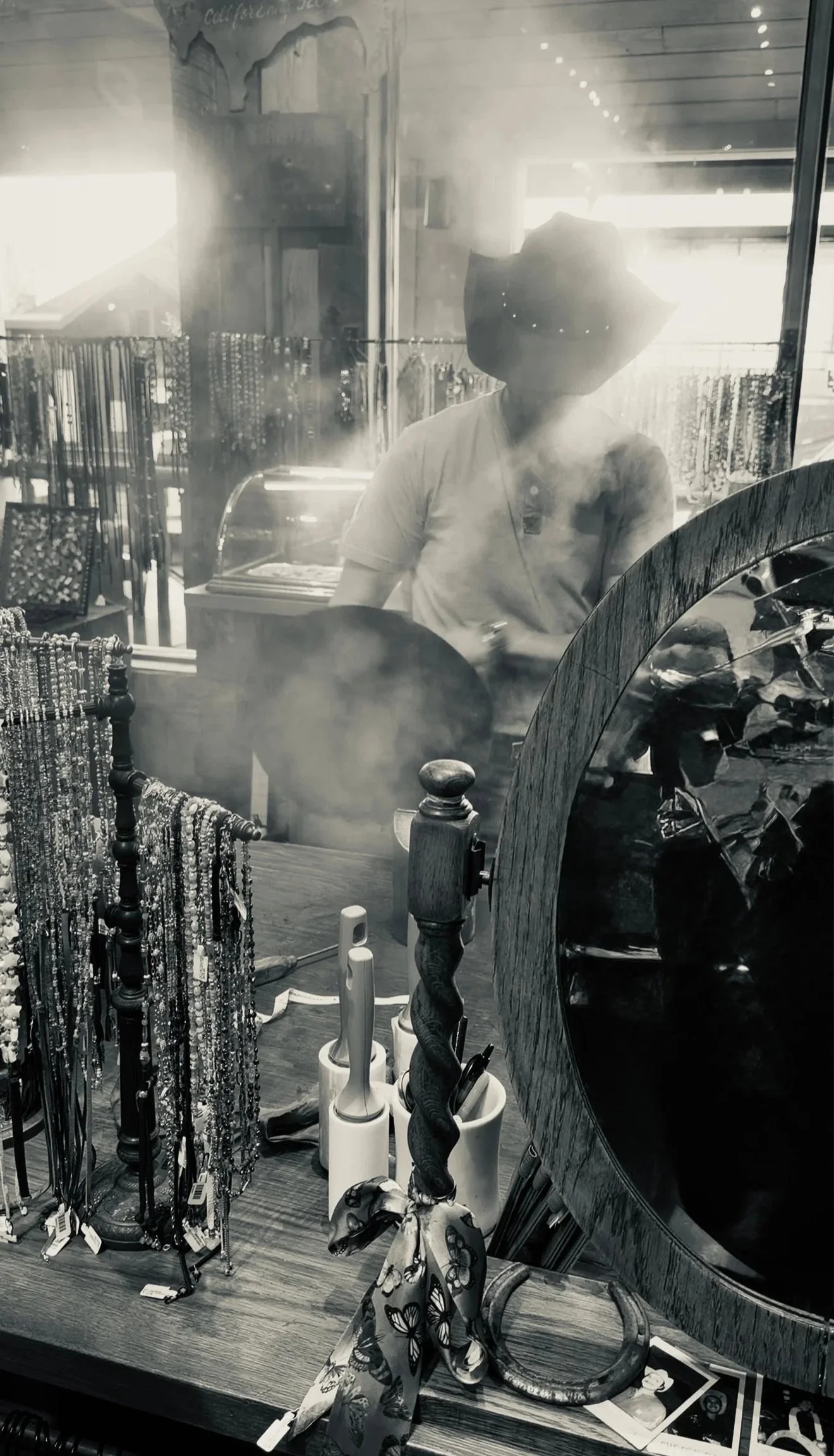
That’s what the maitre d’ couldn’t see. He looked at my hat and did the math on materials. But the hat was never just a hat. It was the souvenir of an experience. And that experience was worth every penny.
To his credit, something shifted during dinner. He comped one of our dishes on his own and had the waiter tell us it was because we were “really nice people.” Maybe he saw my face fall and felt it. Maybe he was having a bad day and his own stuff was leaking into the room. I have no idea what was going on in his life and he is not meant to be a villain in my newsletter. People contain multitudes and bad moments don’t make for bad people.
What I couldn’t help but find interesting was that his instinct to repair the moment was to comp a dish. To give us something we didn’t ask for and were perfectly prepared to pay for. What we expected for FREE was the thing that actually IS free – warmth, a smile, “great hat, welcome in.”
This is the misunderstanding I see everywhere, not just in restaurants, at hotels, in boardrooms, in brands, in leadership. When something breaks emotionally, the instinct is to throw a transaction at it, comp the dish, send the gift card, offer the discount. You cannot buy back a feeling with a transaction. The currency doesn’t convert.
The Kemo Sabe experience was not cheap, it was a luxury purchase and I’m not going to pretend otherwise. But the reason it was WORTH the price is because Caleb built an emotional experience around it that will outlast the hat itself (although that is not what the store guarantees). Without that hour, without his care and craftsmanship and the way he brought our family into the process, it’s just an expensive hat. With it, it’s a memory I carry every time I put it on and that’s what justifies the price. That is what turns a purchase into a souvenir.
This is true at every price point. The restaurant that becomes your regular spot, the one you drag every out-of-town friend to, it’s almost never about a specific dish. It’s about how walking through the door makes you feel. The hairdresser you follow from salon to salon. The mechanic you trust with your car because he once explained what was wrong without making you feel stupid. The colleague who asks how you’re doing and actually waits for the answer. Emotional resonance is what creates value. Whether you’re charging top dollar or nothing at all, it’s the feeling that makes people come back.
The restaurant was part of a corporate hospitality group. And I think that matters. Because somewhere between the brand guidelines and the reservation software, they forgot what hospitality actually means. They’re operating inside a small mountain town built on personal, artisanal, human-scale experiences, and yet a privately owned hat shop understood the assignment better than a hospitality chain with an entire infrastructure supposedly designed around making people feel good.
That’s what happens when you scale the system and optimize out the human.
So this week, think about where you are in this story. Not just at work, though yes, at work too, but in your friendships, in your parenting, in the way you greet someone who walks into your space excited about something.
Are you the person who sees what something cost? Or are you the person who sees what it’s worth?
Are you building the kind of experience people carry with them long after the moment is over? Or are you reaching for a transaction when what someone actually needed was your presence?
It doesn’t take a budget to be Caleb. It takes attention. It takes care. It takes the willingness to treat someone’s excitement as something worth protecting instead of something worth correcting.
That’s not a luxury. That’s a choice. And it’s available to every single one of us.
From Your Biggest Champion,
Nicole
